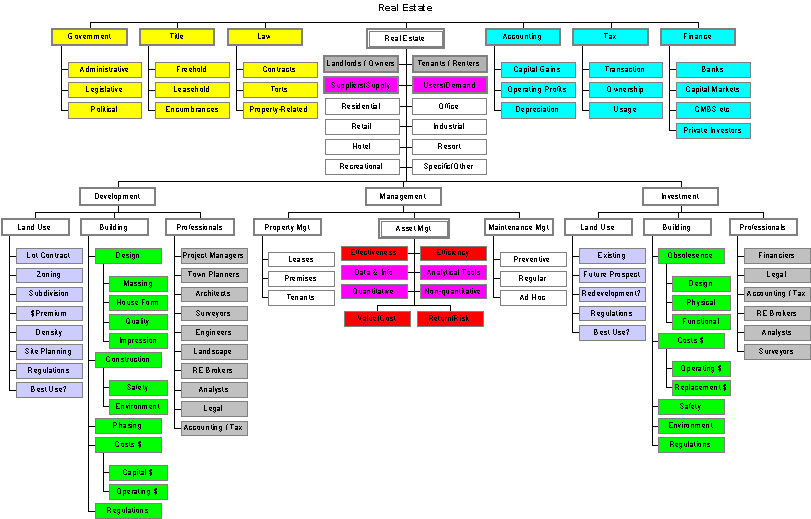
Chart: "Aspects of Real Estate"
By no means is this chart all encompassing or even necessarily the
best-arranged. Nonetheless, it does show you the multi-facet nature of
"real estate", the numerous issues involved, and the various
participants and professionals engaged. Some of the terms here have a
brief description (not necessarily an academic answer or definition
required by examination questions) which will be shown when the term is
clicked.
Descriptions for some of the Terms:
- Real Estate: to most it means the
building(s) (or chattels if you want to be technical) situated upon
the land (lot). Food for thought = real estate is a bundle of rights
e.g. the right to ingress/egress (enter and exit), the right to use,
the right to sell, the right to let/rent out, the right to quiet
enjoyment (not in the physical sense but not to be disrupted/disturbed
unnecessarily) and so on. Without these, real estate may not be worth
much.
- Real Estate Development:
rebuilding upon an existing lot/site or building new upon a virgin
lot/site. Involves major construction activities and the land
utilization is typically altered in terms of use, scale and/or
landscape.
- Real Estate Investment: acquiring existing developments and
buildings for rental income and/or asset appreciation without
involving major rebuilding or construction activities. There may be
some refurbishing work, renovation and/or minor alterations.
- Real Estate Management:
includes managing real estate as financial assets (asset management),
as business operations (property management, lease management, tenant
management and so on), and as physical assets (building maintenance).
- Title: in layman's term, proof of
ownership/possession.
- Freehold: the ownership is forever (perhaps
subject to the timely payment of annual land tax, rates and so on. If
not, there may be a chance for foreclosure or repossession) and this
is not affected by a sale or the death of the original
purchaser/owner.
- Leasehold: the ownership is not forever. In
fact and technically speaking, ownership does not exit. What exists is
just the right of possession for a pre-determined/agreed period of
time, usually in years. In short, it is a lease on the land/lot. When
the lease expires, possession of the land goes back to the (real)
owner (in many cases this may be the government or some public
authorities) unless some form of extension is exercised or agreed.
- Encumbrances: Defects in title, i.e. the
ownership is not free and clear. Typical encumbrances may include
mortgages (usually rid of when the mortgage is fully paid up or
redeemed), building violations, or a claim on title by another party
etc.
- Capital Gains: in simplified terms, the
difference between the acquisition (purchase) price and the
disposition (selling) price. If the latter is larger, there is a gain.
If not, there is no gain.
- Depreciation: the lost in price/value o
an asset due to a variety of reasons such as obsolescence (either not
being in fashion anymore or its application taken over by another
better invention etc), dilapidation (worn down), and the like.
Generally, only the "building" portion can be depreciated,
as land is deemed rather permanent. Depreciation is very useful in
enhancing the cash flow of a real estate investment as the tax
authorities usually allow it to be deducted as an expense yet without
the owner really having to fork it out (though the capital gain, if
any in future, would be higher). This is one advantage which real
estate has over stock investment.
- CMBS: stands for Commercial Mortgage-Backed
Securities, a form of financing available for real estate in the world
of capital markets. Mortgages are securitized and sold to investors.
Just like stocks, there are solid ones and there are highly risky
ones. Consult a finance expert for more details.
- Subdivisions: in North America, this is
usually what a typical land developer does. He/she would acquire a
large tract of land and then "sub-divide" the land into
smaller lots/parcels. The land developer would then sell these lots to
say a home builder and/or to build the homes (or buildings) on them
him/herself. The same may be applied to office or industrial
properties yet the subdivided lot/parcel would be much larger than a
typical residential lot. In Hong Kong, where most live in a high rise
unit, subdivision is not commonly seen and the closest thing would be
"strata-title".
- Density: can be measured or indicated in a
number of ways though at times this can also be a subjective element
on whether a certain development is dense or not. Further, what is
considered dense in one city may be regarded as very spatial in
another. Indicative measures include the Plot Ratio (close to the FAR
Floor Area Ratio commonly used in North America) = the total building
floor area divided by the land (site) area, Site Coverage = the % of
the land (site) area being covered by buildings, Number of
Residents/Occupants per site area, Number of Families per site area
and so on.
- Site Planning: the placing and
allocation of various buildings and facilities on a site. Naturally,
this usually involves larger sites as the options for very small sites
do not exist.
- Massing: the 3-Dimensional allocation and
placement of (permitted floor) "space".
- House Form: Commonly seen ones = detached
houses, bungalows (1-storey detached houses), semi-detached houses,
town or row houses, and high-rise apartments or condominiums.
- Project Managers: In real estate
development terms, the project manager is responsible for managing and
coordinating all necessary functions, processes, procedures, and
professionals/people involved including government authorities,
bankers, brokers and the like from inception to completion. Naturally,
larger companies may have different managers handling the various
development phases. Project managers may come from a variety of
backgrounds, architects, surveyors, engineers, and so on. In North
America, some may even be accountants, analysts or lawyers.
- Town Planners: they are concerned with
the urban planning and development aspects of a city. While many are
focused on the physical planning aspect, there are also some who focus
on the social planning aspect.
- Architects: they design buildings.
Naturally there is more to that, they need to supervise the
construction, administer the contracts, and apply for various building
permits and licenses. While most people would focus on the appearance
of buildings, architecture is actually more a process of creating
"space" in the best possible combination of aesthetics,
costs and use.
- Surveyors: there are several kinds of
surveyors. The common ones include estate/valuation (technically
called General Practice) surveyors (focus on land and real estate
matters), quantity surveyors (focus on building economics and
contractual matters), building surveyors (focus on building
maintenance and regulations), and land surveyors (focus on land
surveys and measurements).
- Engineers: Generally involved in real estate
development are the structural engineer (focus on the building
structures), geotechnical engineer (focus on the soil and slope
matters), civil engineer (focus on the bridges and roads where
applicable), mechanical/electrical/building services engineer (focus
on the various building systems including drainage, plumbing,
ventilation, air-conditioning, electrical supply, telecommunications,
cables and internet systems) and so on.
- Landscape: usually called a landscape
architect or consultant. He/she focuses on the landscape design, use
and aesthetics of open spaces, suitability of various plants and
trees, and so on.
- Real Estate Brokers: or Agents.
They are marketing experts and are knowledgeable of the latest prices
and activities in the market sectors they specialize. They help people
buy/let out and sell/rent real estate.
- Analysts: In real estate terms, they are the
number crunchers though analysis is much more than just
number-crunching. Quantitative analysis is useful but it also has its
limitations and the analytical methods can be simple or sophisticated.
Common sense and a good business intuition also help. Moreover,
analysis can be done on the macro-level, portfolio level and on the
project level. Naturally, most analysts only cover a certain number of
markets or segments of a market.
- Obsolescence: In real estate or building terms, it means becoming
"old" due to: (1) being out of fashion [design-wise], (2)
being replaced by better buildings or inventions [function-wise], and
(3) being really old and worn out [physical-wise].
|
[Home][Website
Objectives][About
Us][Key Executives][Services
Offered][Products Offered][Special
Features]
[Real Estate TECH][Spreadsheets][Tutorials][To
Order][Simple
To Read Stuff][Challenging
Stuff]
[Web Carrying Our Content][Useful
Links][Charts & Tables][Real
Estate 101][Real Estate
Forum]
[Web Team Credit][Contact Us]
 Like Our Web? Click to Recommend-It (r)
Content contained herein
in all or any part of the website, related websites / webpages if any, or
linked websites / webpages if any, is intended for interest or rough
reference only. It is NOT meant to substitute for proper professional
advice or assistance. Visitors, readers, investors or the like are advised
to seek relevant consultation on individual cases, opportunities,
properties or projects. Neither Stephen Chung, Zeppelin nor their
colleagues, staff, associates, consultants, or the like will assume any
responsibility or liability for losses, damages, or claims arising out of
the content contained herein.
A Service of Zeppelin Partners Limited
Phone (852) 37576388 Fax (852) 37576399 E-mail contact@real-estate-tech.com
Address c/o Zeppelin, Unit 1007, 10/F, CCT Telecom Building, 11 Wo Shing Street, Shatin, NT, Hong Kong
Copyright
rests with Zeppelin and/or relevant authors |